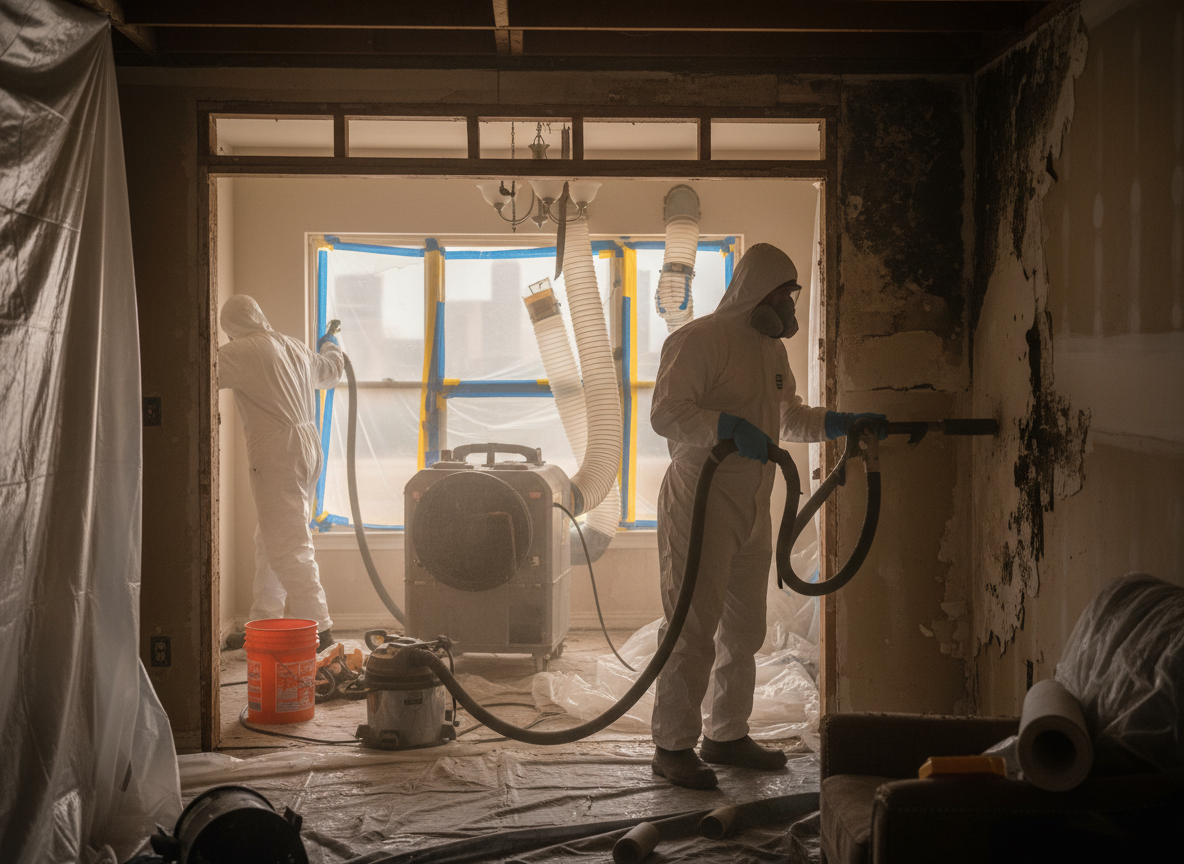
Fort Worth's humid subtropical climate drives rapid mold growth after even small plumbing leaks in pre-1970 homes common in Arlington Heights and the Stockyards. Older plaster and lath walls trap moisture behind surfaces, allowing colonies to spread into insulation and subfloors before visible signs appear. Remediation crews must remove affected materials rather than simply treat surfaces, then apply negative air machines to prevent spores from migrating into adjacent rooms during demolition.
Tarrant County properties near the Trinity River or in low-lying sections of Mansfield and Keller often see repeated moisture intrusion from poor drainage around slab foundations. This creates persistent crawl space and basement mold that standard dehumidifiers cannot fully address without first correcting grading and adding vapor barriers. Technicians document moisture readings at multiple depths in framing to confirm the source is eliminated before reconstruction begins.
In Cultural District and Downtown Fort Worth buildings with mixed brick and frame construction, HVAC condensate lines frequently leak into wall cavities during hot summers. Remediation requires isolating the affected zone with plastic sheeting and HEPA filtration while discarding porous items like carpet padding and drywall. Post-removal air scrubbing and clearance testing verify spore counts return to outdoor baseline levels before occupants re-enter.
TCU-area student housing and nearby rental properties in Arlington Heights frequently experience hidden mold after roof leaks or overflowing toilets on upper floors. Because these structures often lack vapor retarders in attics, remediation includes removing insulation, treating joists with antimicrobial solutions, and improving attic ventilation to reduce future condensation during mild winters.
Technician insight
In Fort Worth, the thing that catches most people out with Mold Remediation is how quickly mold spreads behind plaster walls in Arlington Heights homes once a small pipe leak occurs during our long humid summers. Homeowners often paint over spots only to have it return because the insulation stays wet.
Hidden Mold After Roof Leak in Cultural District
A 1920s home near the Kimbell Art Museum developed ceiling stains after summer rains. Inspection revealed mold throughout the attic insulation and into second-floor joists. Crews removed saturated materials, dried the framing, and added ventilation before new insulation was installed.
Mold Remediation Services We Offer
✓Attic Mold Remediation
Removes mold from insulation and rafters in Fort Worth attics where poor ventilation allows condensation during humid summers.
✓Crawl Space Mold Remediation
Treats mold growth under homes in Tarrant County caused by soil moisture and inadequate vapor barriers in older foundations.
✓Post-Flood Mold Removal
Addresses mold after river or storm flooding in low-lying neighborhoods near the Stockyards and Cultural District.
✓Bathroom Mold Remediation
Targets tile, drywall, and subfloor mold from plumbing leaks common in Arlington Heights and TCU-area homes.
✓HVAC Mold Treatment
Cleans mold from ductwork and coils in Fort Worth properties where condensate drains clog during hot, humid months.
Mold Remediation Cost in Fort Worth, TX
| Service | Typical Range | What Affects It |
|---|---|---|
| Small area (under 100 sq ft) | $600–$1,200 | Single room with surface growth only |
| Medium remediation (100–300 sq ft) | $1,400–$2,800 | Multiple rooms or attic/crawl space work |
| Large or hidden mold job | $3,000–$6,000+ | Extensive wall or floor demolition in older Stockyards homes |
Ranges are typical for Fort Worth, TX and confirmed with an exact written quote before any work starts.
How it works
- 1
Initial Assessment
Technicians inspect affected areas in the home, measure moisture levels in walls and floors, and identify the water source using thermal imaging.
- 2
Containment Setup
Plastic barriers and negative air machines isolate the work zone to prevent spore spread into unaffected rooms.
- 3
Material Removal
Porous materials like drywall, insulation, and carpet are cut out and bagged for disposal while non-porous surfaces are cleaned.
- 4
Drying and Treatment
Air movers and dehumidifiers dry the structure, followed by antimicrobial application to remaining surfaces.
- 5
Final Clearance
Air sampling confirms spore levels match outdoor baselines before reconstruction or re-occupancy.
Pricing
Cost depends on square footage affected, depth of material removal, and whether hidden mold requires wall or ceiling demolition.